


. . . just not for Syracuse. Ever.
So here's the thing: I'm bad at Wednesday deadlines. Plus, with the holiday, my focus wasn't particularly on blog-related items (which, of course, is a mortal sin). But today marks a return to poll participation, a fact that should both dazzle and amaze.
If there are any glaring deficiencies with the ballot below, you know what to do.
| Rank | Team | Delta |
|---|---|---|
| 1 | Ohio State |  25 25 |
| 2 | Michigan | 24 |
| 3 | Southern Cal | 23 |
| 4 | LSU | 22 |
| 5 | Florida | 21 |
| 6 | Louisville | 20 |
| 7 | Wisconsin | 19 |
| 8 | Oklahoma | 18 |
| 9 | Arkansas | 17 |
| 10 | Auburn | 16 |
| 11 | Virginia Tech | 15 |
| 12 | Notre Dame | 14 |
| 13 | Rutgers | 13 |
| 14 | Wake Forest | 12 |
| 15 | West Virginia | 11 |
| 16 | Nebraska | 10 |
| 17 | Texas | 9 |
| 18 | Boise State | 8 |
| 19 | Texas A&M | 7 |
| 20 | Georgia Tech | 6 |
| 21 | Tennessee | 5 |
| 22 | California | 4 |
| 23 | Brigham Young | 3 |
| 24 | Hawaii | 2 |
| 25 | Oregon State | 1 |
Notes:
- I am satisfied with the top four and probably won't acquiesce to challenges concerning the ordering.
- I strongly considered putting Arkansas ahead of Louisville, Wisconsin, and Oklahoma, but I just couldn't bring myself to do it following the tough Razorback loss on Saturday.
- Notre Dame too low? Absolutely not. I have deflated Notre Dame's seeding almost the entire season and the Irish's first-half effort against Southern California solidifies my perception of Charlie Weis' group.
- Wake Forest should probably be higher, but until they rip apart Georgia Tech Saturday, the Demon Deacons will stay behind some bigger guns. Also, if Jim Grobe isn't national coach of the year, it will be a travesty not seen since Jim Brown's Heisman snub in 1956.
- If anyone knows what to do with Boise State, congratulations. I have no clue.
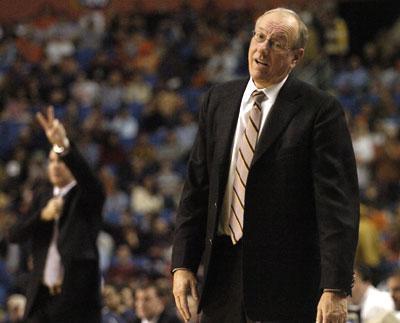 Hey Bernie...these guys still suck.
Another 2nd half effort pulled the Orangemen from a 15 point deficit early in the first half. Shooting only 37.1% from the field in the first half the team did not look sharp, energetic, or ready to play. Out rebounded and out gunned the team finally decided to start playing after the Under 8 Time Out, managing to close the lead for Canisius to only 1 point. The second half saw similar problems with rebounding, and even more dismally was going just under 60% from the free throw line on the day. Yet the Boys From Syracuse managed to pull out another win to continue the win streak over teams from New York to 44.
The orange continue to fail to grab both offensive and defensive rebounds effectively, giving second (and sometimes third) efforts to the opposing squad. The Orange were out rebounded by Canisius 48 to 26. This stat is disturbing thinking about going against Hibbard and Grey on Georgetown and Pittsburgh respectively. On the plus side, the Orange limited their turnovers to 7, which is significantly down from earlier efforts this season, all the while creating 21 turnovers for Canisius.
So the question is, can Jimmy B get his squad to effectively patrol the low post better and convert free trips to the line more? If they can do this, we should be able to effectively handle the Wichita State Shockers and the Oklahoma State Cowboys in Madison Square Garden. Of course, this is all a moot point if we lose to Holy Cross.
I think the format of Matt Glaude's expert analysis and prognostication, and my stern, yet accurate game recaps will be an excellent combo here at Orange::44. Stay tuned this season for even more heartache from your beloved Syracuse Orange(men) and Jim Boeheim.

It's been real.
It's been fun.
But it hasn't been real fun.

Syracuse students agree: Where's Canisius?
The Syracuse effort Wednesday against a spunky Charlotte squad left much to be desired from Orange Nation. Spotty jump shooting, incessant foul trouble, and a poor effort on the offensive and defensive glass may be sufficient to defeat a middle-tier Atlantic 10 foe; it is not, however, the recipe for success in the Big East Conference.
Saturday presents an opportunity for Syracuse to rediscover some semblence of domination. Cansius, a member of Metro-Atlantic Athletic Conference, has put together three less-than-stellar efforts thus far this season, dropping contests to cross-town rival Buffalo and Big East Conference member West Virginia.
The lone victory on the Golden Griffin's schedule is an overtime triumph over Colgate, a team ranked 279th in Ken Pomeroy's ratings.
Unsurprisingly, Syracuse is expected to win fairly convincingly Saturday. If the Orange fail to achieve such success, Orange Nation could quickly become anxious with Holy Cross, Wichita State, and Oklahoma State looming on the horizon.
As always, for an exhaustive explanation of Pomeroy's methodology and statistical theory, this link may be a useful resource.
Offensive Analysis
| Four Factors: Offense | ||||
| Team | Eff. FG | Turn. % | Off. Reb. | FT Rate |
| Syracuse | 54.9 | 24.4 | 33.6 | 35.6 |
| Canisius | 45.8 | 30.4 | 35.1 | 22.2 |
If Canisius is not the worst offensive squad on Syracuse's 2006-2007 schedule, the Golden Griffin's are certainly in the conversation.
There are two issues with the Canisius offensive attack: turnovers and poor three-point shooting.
With respect to the first issue, Cansius simply is not taking care of the basketball. Generating a tempo rating of 74.2 possessions per game, Canisius is getting the basketball up and down the court. Those trips, however, are all too frequently ending with turnovers, as the Golden Griffin's turnover percentage ranks amongst the bottom 15 in Division 1 basketball.
Against a Syracuse 2-3 zone that makes its bones by clogging passing lanes with athletic wing players, Canisius will surely turn the ball over. The question is, though, whether the Golden Griffins can manage how and when those turnovers occur. Tempering its pace may be the best way for Canisius to stop the bleeding when possessing the basketball.
The other Canisius issue -- poor three-point shooting -- is not as easy to remedy and is the ultimate factor affecting the Golden Griffin's success (or lack thereof). On the season, 38.3 percent of Canisius' field goal attempts have come from behind the arc. Such a perimeter-oriented attack is not necessarily a team's undoing. Canisius, however, has only connected on 26.6 percent of its three-point attempts (286th in the country).
Such a recipe has lead the Golden Griffins to accumulate only a 45.8 effective field goal percentage and an offensive efficiency value of 93.3, both around the bottom 100 in the country. That, in and of itself, is not going to be enough to defeat a smarting Syracuse squad.
In essence, the Orange zone inherently forces opponents into attempting a significant amount of three-point attempts. With Canisius connecting so poorly from long-range distances, such a relationship benefits Syracuse greatly, allowing its opponent -- in this case the Golden Griffins -- to take itself out of the game before it has an opportunity to compete.
Thus, it is not surprising to see that the relationship between Syracuse's zone and Canisius' emphasis on the three-point shot will ultimately doom the Golden Griffins.
As for the Orange offense, the modus operandi for 2006-2007 has not significantly changed since its game against Charlotte. The two areas of concern, however, are offensive turnovers and offensive rebounding.
Much has been made of Josh Wright's contributions to the Orange effort this season. As the only true point guard on the Syracuse roster, Wright has been asked to carry a heavy load. With these expectations, though, Wright has unfortunately not risen to the occasion, taking the abuse of many Orange fans due to his penchant for turnovers and poor court vision.
The residue of such performance is Syracuse's middling turnover percentage. Should this team find pace with Eric Devendorf or freshman Paul Harris, the Orange offensive efficiency should skyrocket. If not and Wright is still asked to run the show, Syracuse will continue to suffer growing pains and an unbalanced offensive attack built on its transition game.
As for Syracuse's plummeting offensive rebounding percentage, the primary cause lies with Mookie Watkins' recent foul troubles and head coach Jim Boeheim's desire to play with a smaller lineup. Without an anchor in the center, Syracuse has struggled on the offensive glass. While such an effort will not doom the Orange, focusing on the offensive glass would give Syracuse more opportunities to score, a state of affairs that could counterbalance the team's recent turnover woes.
Defensive Analysis
| Four Factors: Defense | ||||
| Team | Eff. FG | Turn. % | Off. Reb. | FT Rate |
| Syracuse | 40.1 | 23.4 | 30.8 | 27.6 |
| Canisius | 54.7 | 30.4 | 27.3 | 67.6 |
There's one thing that sticks out about Cansius' defense: opponents are getting to the line way too much.
There are two connected issues with such a statement. First, Canisius is obviously getting into foul trouble. As most low-major teams have issues with fielding functional units greater than five deep, Canisius is playing with a loaded weapon. And the gun is trained directly on its own feet.
The secondary issue concerns the lack of contested points Canisius is yielding. Canisius has generated a defensive efficiency value of 108.4, good for 274th in the country. A big piece of its inefficiency, though, is the team's inability to keep opponents from scoring free points.
When not on the free throw stripe, Canisius has done a fairly nice job defensively. The Golden Griffins have done a nice job on the defensive glass, generating a value in the nation's top 70. Moreover, Canisius has also done a nice job turning opponents over, generating the 16th best value in the country.
Thus, if Canisius could just play with a little more discipline, it could keep itself in more games. If Canisius continues to put opponents on the line, though, new head coach Tom Perrotta is going to be looking at a long season.
As for the Orange, things are what they are. Syracuse is within reach of attaining the top spot in block percentage (23.6, 4th in the nation), and has done a nice job forcing opponents into taking bad shots (opponents are shooting only 36.6% on two-point attempts and 30.1% on three-point tries). The real value of the Syracuse defense, however, is that it is forcing opponents into attempting more three point shots than usual (41.7 percent of Syracuse's opponent's field goals have come from three-point distance).
As noted earlier, this should be the aspect of the game that ultimately determines whether Canisius can hang with the Orange. Given the fact that Canisius is so anemic from beyond the arc, Syracuse should have enough defensive might to simply will a victory on the back of Canisius' poor offense.
 That call was bullshit John! Bullshit!
This commentary could be more in depth, but I thought I could just put in as much effort as the team did tonight and still walk away with the win. Stay tuned for the developing soap opera that is SU Basketball.
Syracuse students agree: The best canvas is one's face.
The Monday preceding Thanksgiving signals one thing: college basketball season officially entering "full swing" status.
Syracuse, never to be one late for the hoops bonanza, has already played and won four contests. As a result, some determinations as to the Orange season -- including some analytical projections forecasting Syracuse's performance in future contests -- can reasonably be made.
This Wednesday at 7 P.M., Syracuse welcomes Charlotte to the Carrier Dome for an out-of-conference tilt. The game will mark the 49ers' third game of the season while the Orange hopes to extend its 20-plus point consecutive victory streak to five.
In an effort to preview this game -- which will hopefully become a regular feature on this notebook -- below appears a "Four Factors" analysis premised on Dean Oliver's significant research and Ken Pomeroy's invaluable contribution.
For an exhaustive explanation of Pomeroy's methodology, this link may be a useful resource.
Offensive Analysis
| Four Factors: Offense | ||||
| Team | Eff. FG | Turn. % | Off. Reb. | FT Rate |
| Syracuse | 54.3 | 24.6 | 37.5 | 32.6 |
| Charlotte | 49.5 | 18.6 | 17.8 | 45.9 |
The 49ers are playing with tempo (as noted below), but has done so in an ABA-style: score lots of buckets and get up and down the floor after made attempts. What results is a team that attempts lots of threes in transition (15th in the nation in 3FGA/FGA) and fails to hit the offensive glass.
It's an interesting attack similar (but faster) than what Syracuse saw against its most recent opponent -- Northeastern.
As for the Orange, Boeheim's latest hardwood edition is fairly par for the course. There hasn't been much difference, at least so far, between the 2005-2006 Orange and the 2005-2007 Orange. Save the fact that Syracuse is hoisting fewer three-point attempts, not much has changed (which isn't particularly surprising given Boeheim's track record).
Defensive Analysis
| Four Factors: Defense | ||||
| Team | Eff. FG | Turn. % | Off. Reb. | FT Rate |
| Syracuse | 40.0 | 25.0 | 29.9 | 26.3 |
| Charlotte | 58.5 | 20.5 | 16.7 | 51.8 |
How bad is Charlotte defensively?
Well, in three defensive categories (effective field goal percentage, turnover percentage, and free throw rate), Charlotte ranks in the bottom 100 of the country.
The most glaring aspect of this defensive inefficiency? Charlotte has generated these numbers against North Texas (120 in adjusted offensive efficiency) and Hofstra (214 in adjusted offensive efficiency). That, quite simply, is not going to get it done against a Syracuse squad that turns up the tempo and has generated a respectable effective field goal percentage of 54.3%.
As for the Syracuse defense, it should do a nice job locking down the 49er attack. The Orange has limited opponents to a 40.0 effective field goal percentage and given the fact that Charlotte has only generated an offensive effective field goal percentage of 49.5 against its weak slate of previous opponents, Syracuse should dominate in their 2-3 zone.
There is a tension on the defensive end that will ultimately prove which club wins on Wednesday. Charlotte is gobbled up defensive rebounds against its two opponents; Syracuse has managed to crash the offensive boards. If Syracuse -- through the efforts of Harris, Roberts, and Watkins -- can assert itself on the glass and use its height and athleticism to its advantage, Syracuse should neutralize Charlotte's ability to corral rebounds and alter the effectiveness of the Orange offense.
The other area to watch is whether Syracuse can force Charlotte into turnovers. Syracuse has made a living this year getting out in transition through opponent turnovers. What has resulted is the Orange playing at a relatively high tempo/pace.
Charlotte has also been playing at a high tempo (about 74 possession per contest), yet has done so yielding buckets and possessing the basketball. With Charlotte managing to take care of the basketball, Syracuse's transition game may be stifled. Thus, a careful eye should be trained toward the top of the Orange zone and how wing players like Paul Harris manage to get their hands into passing lanes, creating turnovers and easy basket opportunities.
With that said, the following video should buoy spirits late into the night:
(Hat Tip: John "Mayor McCheese" Macnair)

Happy children posing with big dogs agree:
Connecticut should probably quit playing football.

(Yeah, that joke was pretty lame.)
- Won 20 games against 37 losses (2002-2006);
- Contributed to Syracuse’s school record 11-game Big East Conference losing streak;
- Won a Big East Conference title (2004);
- Lost to Temple twice (2002 and 2004);
- Played under the direction of two head coaches (Greg Robinson and Paul Pasqualoni), two Directors of Athletics (Daryl Gross and Jake Crouthamel), and two Chancellors (Nancy Cantor and Kenneth “Buzz” Shaw);
- Managed to compile a one-win season (2005), Syracuse’s first since 1948 (1-8);
- Scored 1,289 points while yielding 1,589 (2002-2006); and
- Compiled a 15-14 Carrier Dome record (51.7%) (2002-2006).
The reason the preceding information appears is to illustrate a story.
Back in May 2002, I graduated from Syracuse with a Bachelor of Arts in Political Science. With Rudy Giuliani’s address still fresh in my mind, I walked out of the Dome and quickly felt a rush of relief and accomplishment.
I then proceeded to get bleary-eyed drunk.
Now, I wasn’t the greatest student in the world. I drank too much, watched far too much television, and generally put a higher priority on sitting in the Carrier Dome than sitting in class. I finished my tenure, however, with a respectable GPA and was intelligent enough to get into law school and subsequently graduate.
The point is, though, that I was far from a Rhodes Scholar and probably failed to achieve my full academic potential while enrolled as an undergraduate.
Like me almost five years ago, Perry Patterson and Company will walk on the Dome carpet for the final time. Each individual will feel that same sense of relief and excitement I felt. That relief, however, will likely be tempered by feelings of lost opportunity and squandered potential, not unlike my own experience.
The moral of this essay, I suppose, is that these 17 Orange-clad warriors deserve acknowledgement for their accomplishments, no matter how superficially disappointing. Contrary to popular belief, each one busted his ass day-in and day-out to succeed. They were subject to constant ridicule and criticism, probably to an unfair degree (this notebook included in that statement).
In the end, each member of this senior class will walk away as a member of the Syracuse University community having given of themselves so that others could find enjoyment and/or entertainment. For that, they deserve Orange Nation’s gratitude.
Thank you, Seniors.
Now, please learn how to block, because I am absolutely sick of watching this sieve of an offensive line.

There isn't enough space on the internet to assess Syracuse's deficiencies.

Rutgers fans run for cover as the Four Horseman of the Apocalypse
ride through Central New Jersey.

As the Syracuse press release indicates, the Orange will play 13 lacrosse contests in 2007. Eight of those games will be played on the Carrier Dome carpet with another -- a March 10th contest against resurgent Georgetown -- possibly finding a home on The Hill.
In pertinent part, the press release provides as follows:
SYRACUSE, N.Y. * The Syracuse University men's lacrosse team will play 13 games in 2007, six of which will be against opponents who qualified for last year's NCAA Tournament. The upcoming slate is highlighted by a match with defending national champion Virginia on March 3 at M&T Bank Stadium in Baltimore in the inaugural Face-Off Classic.And, of course, the 2007 Syracuse slate:
The Orange and Cavaliers is just one piece of the Face-Off Classic doubleheader. The other game pits Princeton against Johns Hopkins. The four lacrosse powers are the top four teams in Inside Lacrosse's 2007 preseason rankings with Virginia holding the top spot in the poll followed by Johns Hopkins, Syracuse and Princeton. The four schools have combined to win every national championship since 1991.
Ticket prices for the Face-Off Classic will be $10 for groups of 10 or more, $15 for lower level reserved seats and $25 for club level seats. Tickets for the event will go on sale in early December.
The Orange will play at least eight home games in 2007 and could have as many as nine (the location of the Georgetown game has not been determined).
| 2007 Syracuse Lacrosse Schedule | ||||
| Opponent | Date | Location | Time | |
| Hobart | 2.18.07 | Syracuse, NY | 1:00 PM | |
| Army | 2.23.07 | Syracuse, NY | 7:00 PM | |
| Virginia | 3.03.07 | Baltimore, MD | TBA | |
| Georgetown | 3.10.07 | TBA | TBA | |
| Johns Hopkins | 3.17.07 | Syracuse, NY | 3:30 PM | |
| Binghamton | 3.24.07 | Syracuse, NY | 2:00 PM | |
| Loyola | 3.31.07 | Baltimore, MD | 1:00 PM | |
| Princeton | 4.07.07 | Princeton, NJ | 12:00 PM | |
| Cornell | 4.10.07 | Syracuse, NY | 7:00 PM | |
| Rutgers | 4.15.07 | Syracuse, NY | 1:00 PM | |
| Albany | 4.21.07 | Syracuse, NY | 1:00 PM | |
| Massachusetts | 4.28.07 | Amherst, MA | 1:00 PM | |
| Colgate | 5.05.07 | Syracuse, NY | 1:00 PM | |
As the season draws closer, I'll probably take a closer look at the schedule. Until then, though, Syracuse clearly has a tough road to hoe if it hopes to get back to the Memorial Day promised land.

Brick and mortar may even be better.
Or what's exactly going to be in it.
Or where the rest of the cash is going to come from to fund the project.
What Syracuse University does know, though, is that Carmelo Anthony is one of the finest benefactors the institution has ever known.
In a press conference conducted this afternoon, Anthony, along with Orange head basketball coach Jim Boeheim and Director of Athletics Daryl Gross, presented the University with the lead gift for the construction of a newly planned basketball practice facility.
As the Syracuse press release notes, Anthony is paving the way for a world-class facility that ensures the stature of Orange basketball for years to come:
While the completion of the project is likely set two years into the future, it will become, for all intents and purposes, the centerpiece of the now refurbished Manley complex.Anthony’s gift represents one of the largest individual donations to Syracuse University Athletics and is also believed to be one of largest by a current professional athlete to the school they attended. The gift is the starting point in the fundraising plans for the multi-million dollar structure. The facility, which is still in the planning phase, would be located within the Lampe Athletic Complex on the University campus.
“This is deeper than the money,” Anthony said. “It is my commitment to give back to Syracuse for what they gave me when I was there. They embraced me. It is just another way I can give back. I am giving back in Baltimore and Denver, but the one in Syracuse, I think that is going to be huge.”* * * * *
The planned facility would house two practice courts, locker rooms and office facilities for the men’s and women’s basketball programs at Syracuse.
. . . for freedom. And cheese fries.
Definitely cheese fries.
That, of course, has not happened. With teams alternatively struggling, losing, and generally disappointing in big spots, more chaos has hit this pull over the last seven days than originally anticipated. What results is a poll with an odd mix of green and red arrows, and eight sets of dashes representing nonmovement. Such a combination is worrisome, yet given the slate of games played last week, it is not as disorderly as it could have been.
| Rank | Team | Delta |
|---|---|---|
| 1 | Ohio State | -- |
| 2 | Louisville | 4 |
| 3 | Michigan |  1 1 |
| 4 | Texas | -- |
| 5 | Auburn | -- |
| 6 | Florida | 1 |
| 7 | West Virginia | 4 |
| 8 | California | 1 |
| 9 | Southern Cal | 1 |
| 10 | LSU | 3 |
| 11 | Arkansas | -- |
| 12 | Tennessee | 4 |
| 13 | Notre Dame | 1 |
| 14 | Rutgers | -- |
| 15 | Wisconsin | -- |
| 16 | Boise State | -- |
| 17 | Oklahoma | -- |
| 18 | Wake Forest | 3 |
| 19 | Georgia Tech | 1 |
| 20 | Oregon | 6 |
| 21 | Texas A&M | 1 |
| 22 | Brigham Young | 2 |
| 23 | Maryland | 3 |
| 24 | Virginia Tech | 2 |
| 25 | Nebraska | 1 |
Notes & Commentary
- Boston College's treatment was harsh, but I feel justified in the action. The Eagles are a schizophrenic team, dogged week-to-week with questionable offensive and defensive consistency. With losses against N.C. State and Wake Forest -- games Boston College was expected to not only win, but win fairly handily -- the allure of the Eagles is quickly fading. Considering that Tom O'Brien's outfit has yet to register a win of sizable proportion -- Clemson victory included -- there isn't much for the Eagles to stand behind save a close shave over Brigham Young.
- The back-end of this ballot, once again, is pretty terrible. I like Maryland and Virginia Tech rated somewhere in the final five, however, I am not particularly sold on any of the other teams included in the final grouping.
- Despite the Muderer's Row of opponents lining up for Wake Forest, I still like the Demon Deacons. They definitely have some fight and Jim Grobe's offense is a pleasure to watch.
- Does Louisville deserve the number two spot? Well, maybe. Brian argues that we should examine the full resumes of Louisville and Michigan in order to make an informed decision on the 2-hole. I agree, yet think that there is something to be said about Louisville's recent progression. With Brian Brohm close to operating at 100%, Louisville is starting to peak in its performance. Michigan, unfortunately, ran into a roadblock against Ball State. While not necessarily "exposing" the Wolverines, it did put a chink in the Michigan armor. Given the fact that Louisville did topple the clear number three team in the country and played enough defense to stymie that attack, I have to move the Cardinals into the second slot. Michigan, though, is a close third.
- If Rutgers beats Louisville on Thursday, I will seriously consider them as a top 10 team. Repent now, the end is obviously near.
- Good-bye, Clemson. It's been nice knowing you. Take a seat next to Pittsburgh.
- I have no idea what to do with Arkansas. I think 11 is fair, but the Razorbacks may be a significantly better team than that. Time will have to tell in this situation.
- LSU probably deserves better, but the "big win" came against a Tennessee squad without its starting quarterback. And, the victory may have been the ugliest on the week, outside of the Louisville-West Virginia joint. So, the Tigers kind of tread water at the 10-hole.